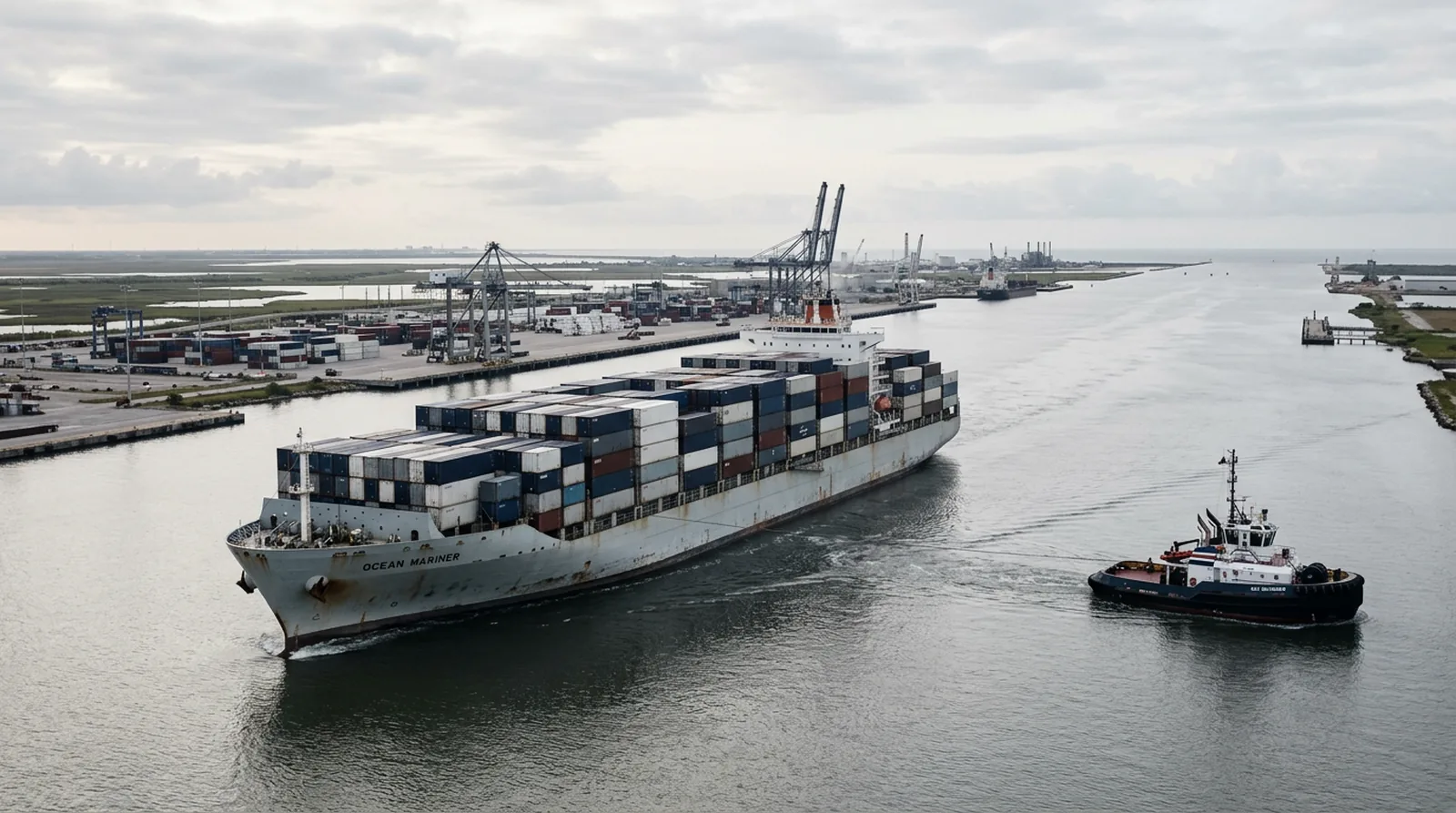
What is freight?
In commodity trading, freight is the cost and contractual framework for moving cargo by sea from a load port to a discharge port. It is bought either by chartering a whole vessel — on a voyage, time or contract-of-affreightment basis — or by booking space on scheduled liner services, typically in containers.
The governing documents are the charter party (for chartered tonnage, often on standard forms such as GENCON for dry cargo or ASBATANKVOY and BPVOY for tankers) and the bill of lading, which acts as a receipt, evidence of the contract of carriage and, when negotiable, a document of title financed by banks.
Freight is priced in US$ per metric tonne or as a lump sum for voyage charters, in US$ per day for time charters, and per container (TEU/FEU) for liner cargo, with bunker, port and canal costs allocated by the contract.
Grades & forms
Product tankers
General Purpose (10–25k DWT), Medium Range (25–55k DWT), LR1 (55–80k DWT) for refined fuels.
Dry bulk
Handysize (15–40k DWT), Supramax/Ultramax (50–65k DWT), Panamax (65–85k DWT) for scrap, steel and minerals.
Bitumen carriers
Specialised heated tankers, typically 2,000–15,000 DWT.
General cargo / multipurpose
Geared vessels for breakbulk steel, project cargo and small ports.
Container liner
20' and 40' dry, high-cube and flat-rack equipment on scheduled services.
Barge & coastal
Short-sea and inter-island distribution, often under local cabotage rules.
Specifications
Key charter party terms
| Parameter | Limit / value |
|---|---|
| Laycan | Window in which the vessel must present at the load port |
| Laytime | Time allowed for loading/discharge (e.g. SHINC / SHEX terms) |
| Demurrage / despatch | Daily rate payable for excess time / earned for early completion |
| Notice of Readiness (NOR) | Triggers laytime once the vessel is arrived and ready |
| Freight payment | Typically on or after signing/releasing bills of lading |
Values summarise commonly referenced public standards for orientation only. The specification attached to the executed contract always governs.
Trade terms
- Charter types
- Voyage charter (port-to-port, freight per MT or lump sum), time charter (vessel hired by the day), and contract of affreightment (fixed volume over a period across multiple liftings).
- Incoterms interaction
- Under FOB the buyer arranges freight; under CFR/CIF the seller does. Laytime and demurrage provisions in the SPA must mirror the charter party to avoid unrecovered costs.
- Insurance
- Marine cargo insurance (Institute Cargo Clauses A/B/C) and, for chartered tonnage, confirmation of the owner's P&I club entry and hull & machinery cover.
- Documentation
- Bills of lading, mate's receipt, NOR, statement of facts, ullage/draft survey reports and cargo manifests.
- Sanctions & vetting
- Vessel screening against sanctions lists, AIS history and, for tankers, SIRE/OCIMF vetting.
Use cases
Delivered (CFR/CIF) sales
Freight structured into the cargo price so the buyer receives a single delivered quote.
FOB buyers
Chartering support for buyers lifting from US Gulf or Caribbean terminals.
Term programmes
Contracts of affreightment for recurring fuel, bitumen or steel deliveries.
Inter-island distribution
Small-parcel coastal shipping from regional hubs to outer islands.
Logistics
- Port restrictions (draft, LOA, berth availability) determine the largest vessel class that can serve a lane.
- Panama Canal transit constraints affect Pacific–Caribbean routings and timing.
- Hurricane season (June–November) is factored into laycan and insurance planning.
Related services
- Private Credit & Insurance Wrappers — Private credit combined with credit insurance, guarantees and collateral control to bridge the gap between shipment and payment.
- Feedstock & Offtake Sourcing Agreements — Term supply for processors and committed offtake for producers, with verification and documentation built to bankable standards.
Frequently asked questions
- Do you act as a shipbroker?
- We arrange freight as part of the trades we structure and work with licensed brokers and owners; we do not hold out as a stand-alone shipbroking firm.
- What drives demurrage risk?
- Port congestion, slow documentation, terminal restrictions and weather. Clear laytime terms and back-to-back SPA provisions limit the exposure.
- Can freight be fixed for a full year?
- Yes — a contract of affreightment can lock in rate and capacity across a programme of liftings.
Supplier directory
Lane guides for each freight product by city, US state and FOB port:
Freight & Shipping Suppliers
- Freight & Shipping Suppliers In Kingston, Jamaica
- Freight & Shipping Suppliers In Montego Bay, Jamaica
- Freight & Shipping Suppliers In Port of Spain, Trinidad and Tobago
- Freight & Shipping Suppliers In San Fernando, Trinidad and Tobago
- Freight & Shipping Suppliers In Santo Domingo, Dominican Republic
65 lane guides