What is steel?
Steel is an alloy of iron and carbon, produced either in blast furnace–basic oxygen furnace (BF-BOF) routes from iron ore or in electric arc furnaces (EAF) that melt scrap and direct-reduced iron. Molten steel is cast into semi-finished forms — slab, billet and bloom — and then rolled into finished products.
Traded steel splits broadly into flat products (hot-rolled coil, cold-rolled coil, plate, coated sheet) and long products (rebar, wire rod, merchant bar, sections, rails). Each is sold against a recognised standard — ASTM, EN, JIS or GB — with chemistry, mechanical properties and dimensional tolerances evidenced by a mill test certificate (EN 10204 3.1).
Prices reference regional benchmarks (US Midwest HRC futures on CME, Turkish rebar and scrap import assessments, and Asian export HRC), adjusted for grade extras, size extras, freight and trade measures such as anti-dumping duties and US Section 232 tariffs.
Grades & forms
Hot-rolled coil (HRC)
SAE 1006/1008, ASTM A1011 CS/SS, EN 10111 / S235–S355; typically 1.2–25 mm thick, 900–2,000 mm wide.
Cold-rolled & coated coil
CRC (ASTM A1008), hot-dip galvanised (ASTM A653) and pre-painted galvanised (PPGI) for roofing and appliances.
Rebar (deformed bar)
ASTM A615 Grade 60 / A706, BS 4449 B500B; 8–40 mm diameters in straight lengths or coil.
Billet & bloom
Semi-finished 3SP/5SP billets (100–150 mm square) for re-rolling mills.
Wire rod
SAE 1006–1018, 5.5–14 mm, for mesh, nails and wire drawing.
Structural sections & plate
I-beams, H-beams, channels and angles (ASTM A36/A992, EN S275/S355) and heavy plate.
Specifications
Rebar — ASTM A615 Grade 60 (420)
| Parameter | Limit / value | Test method |
|---|---|---|
| Minimum yield strength | 420 MPa (60,000 psi) | ASTM A370 |
| Minimum tensile strength | 620 MPa (90,000 psi) | ASTM A370 |
| Elongation in 8 in (#3–#6) | ≥ 9 % | ASTM A370 |
| Bend test | Per bar size, no cracking | ASTM A615 |
HRC — SAE 1006 commercial quality (typical chemistry)
| Parameter | Limit / value | Test method |
|---|---|---|
| Carbon (C) | ≤ 0.08 % | — |
| Manganese (Mn) | ≤ 0.45 % | — |
| Phosphorus (P) | ≤ 0.030 % | — |
| Sulphur (S) | ≤ 0.035 % | — |
| Thickness tolerance | Per ASTM A568 / A635 | Mill certificate |
Values summarise commonly referenced public standards for orientation only. The specification attached to the executed contract always governs.
Trade terms
- Incoterms
- FOB mill port or CFR FO (free out) to destination for breakbulk; CIF/CFR container for smaller lots and coated products.
- Quantity & tolerance
- Breakbulk lots usually from 1,000–5,000 MT per size; containerised lots from one 20' container (≈ 25 MT). Tolerance ±5–10% per size and in total.
- Pricing basis
- US$ per metric tonne, base price plus grade/size extras; index-linked pricing available against published HRC or rebar assessments.
- Payment instruments
- Irrevocable documentary letter of credit (UCP 600) at sight or deferred, standby letter of credit (ISP98) supporting open-account terms, or cash against documents for established counterparties. Proof of funds and proof of product are exchanged only after KYC is complete.
- Documentation
- Mill test certificates (EN 10204 3.1), certificate of origin, packing list with heat numbers, and third-party inspection of dimensions, weight and surface condition.
- Trade measures
- Destination duties, anti-dumping/countervailing orders and US Section 232 measures are checked against origin before contracting.
Use cases
Construction & infrastructure
Rebar, mesh and sections for housing, hotels, ports and public works.
Fabrication & manufacturing
HRC and plate for tanks, structures, pipe, trailers and machinery.
Roofing & cladding
Galvanised and pre-painted coil for the region's hurricane-rated roofing market.
Re-rolling mills
Billet supply for regional mills producing local rebar and merchant bar.
Logistics
- Breakbulk on Handysize/Supramax vessels with geared cranes suits ports without heavy-lift infrastructure.
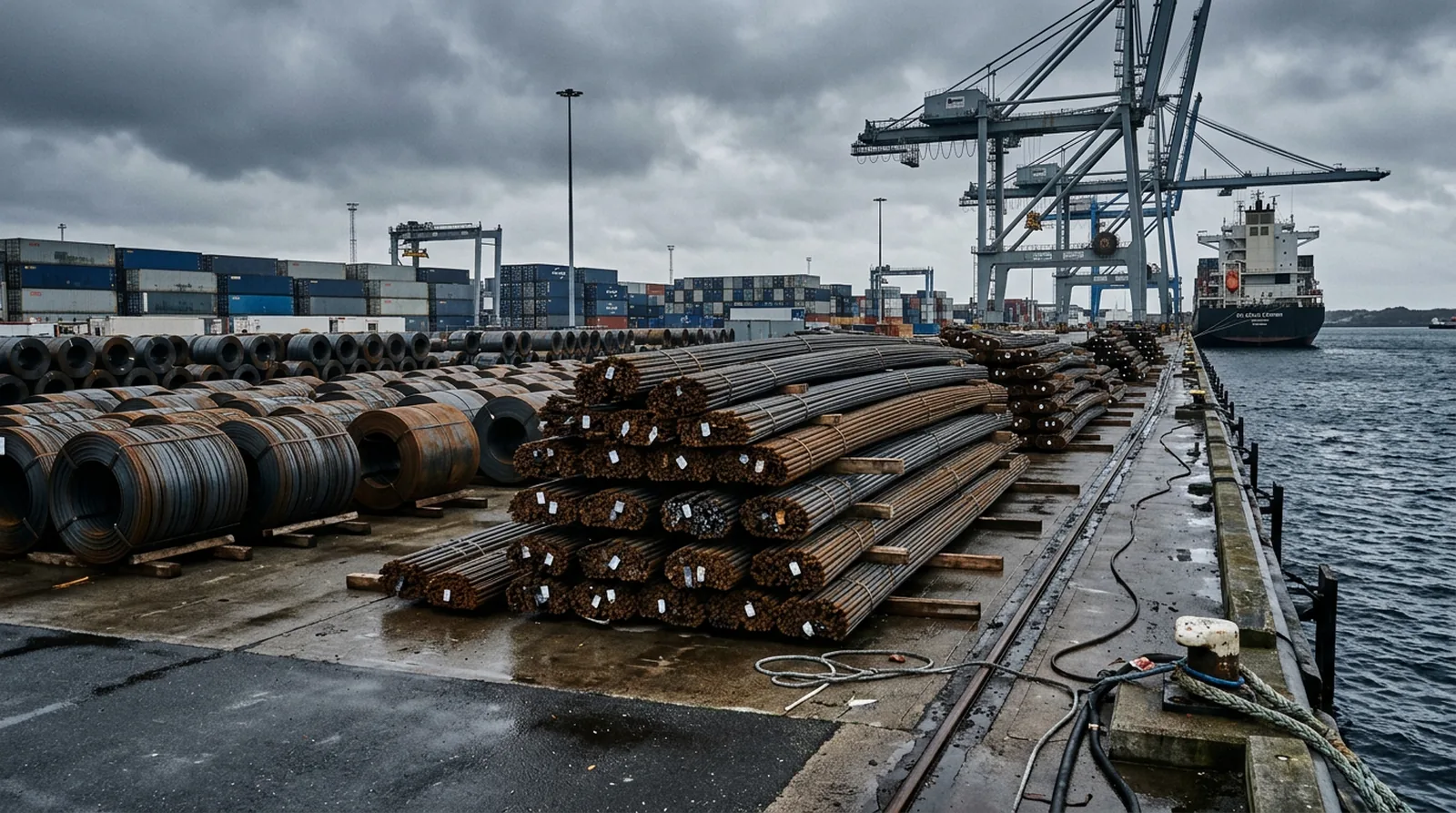
- Coils are lashed and dunnaged to prevent shifting; rebar bundles are tagged by heat number.
- Containerised shipments reduce handling damage for coated products and small lots.
Related services
- Feedstock & Offtake Sourcing Agreements — Term supply for processors and committed offtake for producers, with verification and documentation built to bankable standards.
- Tolling Agreements — Processing capacity without owning the asset: we structure, finance and administer tolling programmes between feed owners and independent processors.
- Private Credit & Insurance Wrappers — Private credit combined with credit insurance, guarantees and collateral control to bridge the gap between shipment and payment.
Frequently asked questions
- Can you supply mill-direct?
- Where volumes justify it we work mill-direct; otherwise we source from established trading houses holding allocations, always with mill certificates traceable to heat numbers.
- Which rebar standard do I need?
- Your structural engineer's specification governs. ASTM A615/A706 is typical for US-designed projects; BS 4449 B500B for British-influenced codes common in parts of the Caribbean.
- Do you handle anti-dumping and tariff checks?
- We screen origin against the destination's trade-remedy orders before contracting and reflect any duties in the landed-cost model.
Supplier directory
Lane guides for each steel product by city, US state and FOB port: